Prepping Is More Than Surviving the First Emergency
Most people begin their preparedness journey with food, water, and basic supplies. That’s a good start, and it’s necessary. Short-term prepping is “a given.” If you don’t have enough food and water to carry you through immediate disruptions, nothing else matters. But preparedness doesn’t end there. Real resilience begins when you start thinking past the first month, the first winter, and even the first year.
Short-term disruptions are already happening. We’ve seen supply chains falter, healthcare systems strain, and government assistance programs wobble. SNAP benefits nearly stopped for weeks. Healthcare services were affected. These weren’t theoretical events. They happened while the grid was still mostly intact. Preparedness is no longer about imagining the collapse—it’s about recognizing instability and planning wisely.
The Difference Between Short-Term and Long-Term Thinking
I prepare for the short term, just like anyone else who takes responsibility seriously. Food, water, medicine, heat, and basic supplies are non-negotiable. Beyond that, I also store digital information on hard drives for situations where the grid is shaky but still functioning. Offline files, manuals, references, and guides can be incredibly useful when power is intermittent and the internet becomes unreliable.
But digital storage has limits. Hard drives fail. Devices break. Solar systems degrade. Batteries wear out. Moisture, heat, time, and simple wear take their toll. Digital knowledge is useful for the short to mid-term, but it is not permanent. If the grid goes down and doesn’t come back for years—or doesn’t come back at all—digital knowledge becomes inaccessible.
Knowledge Is the Most Overlooked Prep
Water and food keep you alive. Knowledge keeps you rebuilding. But most people never think about what happens after their stored supplies run low or out. What happens when something breaks and there’s no YouTube tutorial? What happens when a skill is needed but no one remembers how it’s done? What happens when the people who knew how to live without systems are gone? And that awesome stock of information on your hard drive…what happens when it corrupts after the grid goes dark?
This is where most prepping stops short. People prepare for disruption, not continuity. They prepare for survival, not sustainability. Long-term preparedness means preserving knowledge that can be passed down, taught, and reused without electricity or technology. Bottom line, books, printed and carefully secured material will be there when you need it.
Books Are Permanent Infrastructure
Books don’t need power. They don’t need updates. They don’t depend on fragile systems. A book printed today can still teach someone fifty or a hundred years from now. For thousands of years, books have carried human knowledge through wars, collapses, and dark ages. They are one of the most resilient technologies ever created.
A well-chosen library becomes a survival tool. Not entertainment. Not decoration. A tool. Books turn into teachers when teachers are gone. They become reference points when memory fades. They preserve skills long after systems fail.

What a Smart Prepper Library Contains
A prepper library doesn’t need to be massive, but it needs to be practical. It should contain knowledge that supports daily life without modern infrastructure. Food preservation methods. Gardening and saving seeds. Herbal medicine. First aid. Animal care. Mechanical repair. Carpentry. Cooking from staples. Off grid living. Basic engineering and problem-solving skills. These are the skills humanity has always relied on when systems fall away.
This isn’t about nostalgia. It’s about functionality. A prepper library should answer real questions that arise in a grid-down world. How do I preserve food without refrigeration? How do I treat illnesses when clinics aren’t available? How do I repair tools instead of replacing them? How do I keep producing food year after year?
Why We Write and Stockpile Our Own Books
Most of the books on our shelves are books by Author Cheyenne James (my partner) and I wrote and published ourselves. That isn’t accidental. We write the kinds of books we want on our own shelves—books designed to be used when the grid is down, when technology is gone, and when knowledge needs to be simple, clear, and repeatable.
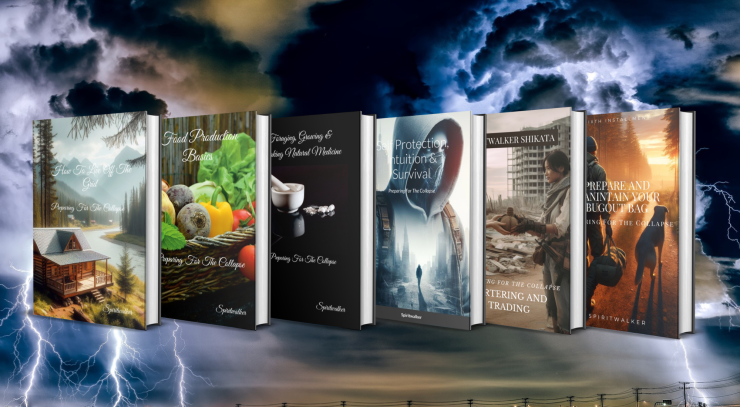
The Preparing for the Collapse series was created with long-term thinking in mind. These books aren’t dependent on trends, platforms, or digital access. They are written to stand alone, to teach without the internet, and to be used as practical references in real situations. They are meant to be part of a working library, not a forgotten file on a hard drive.
Prepping Is Stewardship
Long-term preparedness isn’t about fear. It’s about responsibility. It’s about understanding that systems rise and fall, but knowledge is what allows communities to endure. When you stockpile information alongside food and water, you’re not just preparing for yourself—you’re preparing for those who come after you. Food will eventually be eaten. Water will eventually be used. Knowledge, when preserved properly, doesn’t run out. It compounds. It passes forward. And in times when the world feels unstable, that may be the most valuable prep of all.

Discover more from Forgotten Wisdom Blog
Subscribe to get the latest posts sent to your email.
 Forgotten Wisdom Blog